July 2026 Property Tax Update: New Credits, Extended Due Dates & What It Means for Ohio Homeowners

If you’ve been waiting for your second-half property tax bill this summer, you’re not alone.

Several Ohio counties have delayed mailing tax bills and extended payment deadlines while implementing Ohio House Bill 186, legislation signed by Governor Mike DeWine that created the new Inflation Cap Credit. The law required county auditors and treasurers across the state to update tax software, recalculate qualifying property tax bills, and issue revised tax statements before bills could be mailed.

For homeowners, realtors, buyers, and sellers, here’s what you need to know.

Why Are Property Tax Bills Delayed?

Normally, second-half real estate tax bills are issued in late June or early July. This year, implementation of House Bill 186 required counties throughout Ohio to modify tax calculation systems before certifying tax bills.

Because the new credit applies to qualifying school operating levies for Tax Year 2025, every affected county had to complete extensive recalculations before tax bills could be finalized.

The result has been delayed billing schedules and extended payment deadlines in several counties.

Current Southwest Ohio Due Dates

As of July 9, 2026, the following due dates have been announced:

County Second-Half 2025 Property Tax Due Date
Auglaize August 14, 2026
Brown July 31, 2026
Butler July 19, 2026
Clark August 7, 2026
Clermont August 7, 2026
Clinton July 31, 2026
Darke Not yet announced (anticipated early August)
Franklin July 20, 2026
Greene August 14, 2026
Hamilton July 24, 2026
Highland August 7, 2026
Miami August 20, 2026
Montgomery July 24, 2026
Preble July 31, 2026
Shelby August 3, 2026
Warren August 12, 2026

Late Payment Penalties

Most Ohio counties apply the following statutory penalties for late payment of real estate taxes:

  • 5% penalty if payment is received within the first 10 days after the due date.
  • 10% penalty if payment is received more than 10 days after the due date.

Exceptions: The following counties assess a 10% late penalty immediately after the due date, without the initial 5% grace period:

  • Darke County
  • Montgomery County
  • Preble County

Note: Due dates and penalty policies are current as of publication but may change. Property owners should always verify payment deadlines and late-payment policies with their county treasurer before remitting payment.

What Is the Inflation Cap Credit?

House Bill 186 established the Inflation Cap Credit, sometimes referred to as the 20-Mill Floor Credit, to provide targeted property tax relief in qualifying Ohio school districts following recent increases in property values.

The amount of any credit depends on several factors, including the property’s taxable value, school district, and applicable operating levies. As a result, some homeowners may see a noticeable reduction on their tax bill, while others may receive a smaller credit—or none at all.

Why School District Matters

One of the biggest questions homeowners have is why neighbors living only a few miles apart may receive very different tax credits.

The answer lies in each school district’s levy structure.

Districts that were already at or near Ohio’s statutory 20-mill floor generally will experience little or no change under House Bill 186. Other districts may qualify for larger credits depending on their existing operating levies and recent increases in property values.

Montgomery County: Why the Delay Was More Significant

Montgomery County experienced additional complexity because multiple school districts are affected by the new calculations, including districts that participate in the Montgomery County Career Technology Center (CTC) tax structure.

School districts associated with the Montgomery County CTC include:

  • Huber Heights
  • Brookville
  • Northmont
  • Jefferson Township
  • Northridge
  • Trotwood-Madison
  • Vandalia-Butler

Additional Montgomery County school districts affected by the new calculations include:

  • Miamisburg
  • Valley View
  • New Lebanon
  • Centerville
  • Kettering
  • Dayton
  • Oakwood
  • Mad River

Because each district has different levy structures, tax calculations had to be updated individually before Montgomery County could certify and issue second-half tax bills.

What This Means During Your Closing

Fortunately, these changes should have little impact on most real estate transactions.

Title companies routinely prorate property taxes between buyers and sellers using the best certified tax information available at the time of closing. When updated tax bills have not yet been issued, Ohio’s established closing procedures allow transactions to proceed while ensuring taxes are prorated fairly.

If revised tax information becomes available before closing, settlement figures can be adjusted accordingly.

What Homeowners Should Do

If your mortgage company escrows your property taxes, you generally do not need to take any action. Your lender will receive the tax bill and submit payment by the applicable due date.

If you pay property taxes directly:

  • Watch for your official tax bill.
  • Review your bill for any Inflation Cap Credit that may apply.
  • Pay by your county’s revised due date to avoid penalties.

Landmark Is Here to Help

Legislative changes like House Bill 186 often generate questions for homeowners, REALTORS®, buyers, sellers, and lenders. While Landmark Title Agency South cannot provide tax or legal advice, our experienced closing professionals closely monitor changes affecting Ohio real estate transactions and are happy to explain how delayed tax bills or revised due dates may impact your closing.

If you have questions about property tax prorations or your upcoming transaction, contact the Landmark Title Agency South team. We’re committed to making every closing smooth, accurate, and stress-free. 937.432.6300

This information is current as of July 9, 2026. Property tax due dates and county announcements are subject to change. Homeowners should always verify payment deadlines with their county treasurer.


Read more

Why Title Work Matters More Than Ever

Risk, Fraud, and the Real Value Behind Every Closing

In today’s real estate environment, the closing table is more than a final step—it’s a critical checkpoint in a transaction filled with legal, financial, and cybersecurity risk.

And those risks are not hypothetical. They are measurable, costly, and increasing.


Fraud Is Real—and Expensive

Cybersecurity

Real estate fraud continues to be one of the most serious threats in a transaction.

According to the American Land Title Association (ALTA), fraud and forgery claims represent approximately 21% of total title insurance claim costs, with the average claim exceeding $143,000. Refinance-related fraud claims are even higher, averaging more than $200,000 per claim.


At the same time, cybercrime is accelerating. The Federal Bureau of Investigation reports that business email compromise (BEC)—a common tactic used in real estate wire fraud—contributed to billions of dollars in losses annually, with total cybercrime losses reaching $16.6 billion in 2024.

Most fraud doesn’t start at the closing table. It starts in your inbox.


Title Work Is Risk Prevention—Not Paperwork

Risk Management

One of the biggest misconceptions in real estate is that title work is administrative.

In reality, it is one of the most important forms of risk prevention in the entire transaction.

ALTA reports that the title industry helps mitigate between $600 billion and $900 billion in potential risk exposure annually, with that number exceeding $1 trillion during peak market periods.


Additionally, nearly 30% of title claims involve issues that are not discoverable through public records alone. This means many of the most serious risks require professional expertise to identify and resolve.

These issues can include:
Unknown heirs
Forged or improperly recorded documents
Undisclosed liens
Errors in legal descriptions

Many of the most costly problems are invisible without expert review.


Claims Data Reinforces the Need for Protection

Data protection


Title insurance is not theoretical. It is backed by real claims activity.

ALTA reports that the industry paid more than $336 million in claims in the first half of 2025 alone, demonstrating the ongoing need for protection against title defects and fraud.


This is what title insurance is designed to do:
Identify issues before closing
Resolve them whenever possible
Protect property owners and lenders when issues arise


Cybersecurity Is Now Part of Every Closing

Secure file with padlock


ALTA’s Cybercrime and Wire Fraud Study found that:
Over 90% of title companies report cyberattack attempts are increasing or staying the same
Nearly 60% have experienced attempted fraud, including wire fraud and business email compromise


These findings reinforce an important reality: Security is no longer optional. It is essential.

At Landmark Title Agency South, that means:
Verifying all wire instructions
Using secure communication protocols
Educating clients and partners on fraud prevention


A Strong Industry Backing Every Transaction

Alta Logo


The title industry remains a stable and essential part of the real estate market.


According to ALTA:

$3.9 billion in title insurance premiums were generated in Q1 2025
$4.5 billion in Q2 2025
$16.2 billion total premiums in 2024

These numbers reflect an industry built on protecting property rights and financial security. One that is supported by strong reserves and consistent claims performance.


Technology Is Advancing—But Expertise Still Leads

Data analysis

The title industry continues to evolve with digital tools and closing innovations.

ALTA reports that the number of title companies offering digital closings has increased significantly in recent years, reflecting growing demand for efficiency and convenience.

But while technology improves speed, it does not replace expertise.

Careful review by skilled staff, informed judgment, and accountability remain at the core of a secure closing.


The Landmark Difference

Landmark Team 2026


For buyers, sellers, lenders, and real estate professionals, the value of title work is not always visible.


It’s found in what doesn’t happen:
The fraud that is prevented
The issue that is caught early
The risk that is resolved before it becomes a problem

At Landmark Title Agency South, every closing is approached with that responsibility in mind. We combine experience, precision, and protection to ensure your transaction is not just completed, but completed with confidence.

_________________
Sources
American Land Title Association (ALTA) – Claims Analysis; Market Share & Premium Reports; Cybercrime & Wire Fraud Study
Federal Bureau of Investigation – Internet Crime Report 2024 (Business Email Compromise & Cybercrime Losses)

Read more

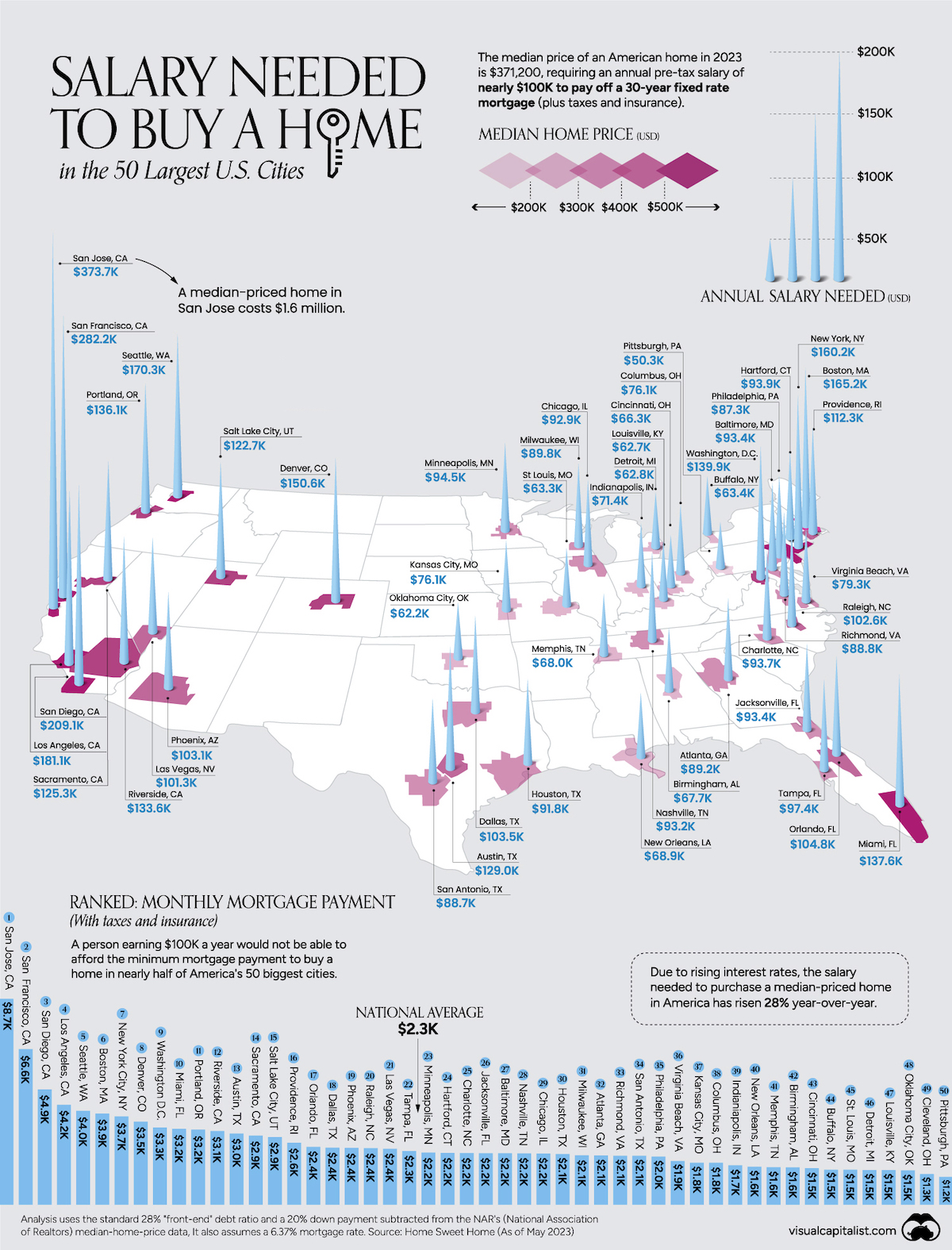
Mapped: What You Need to Earn to Own a Home in 50 American Cities

(Source: Home Sweet Home & Visual Capitalist)

A map of the U.S. with the median home price as well as the salary needed to own a home 50 American cities.

Once a fundamental part of the American dream, the ability to own a home is drifting farther and farther away for many Americans.

Between skyrocketing prices, stagnating wages, and now rising interest rates, the deck seems to be increasingly stacked against home ownership.

Using May 2023 data tabulated by Home Sweet Home, we map out the annual salary needed to afford a 30-year mortgage (at 6.37%) to buy a home in America’s 50 most populous metropolitan areas.

The monthly minimum mortgage payment includes taxes and insurance as well, and is capped at roughly one-third of the income. This analysis also assumes that the homeowner will put down a 20% down payment.

The Least and Most Affordable American Cities to Own a Home

At the top of the list, and at the very west of the country, San Jose is the least affordable city to own a home for the average American.

One would have to earn at least $374,000 a year to afford a $1.6 million dollar home in the city.

To put those numbers into perspective, the median American annual income is $75,000, about one-fifth what’s required to buy a home in San Jose.

Other Californian cities, San Francisco (ranked 2nd), San Diego (3rd), and Los Angeles (4th) all require an annual income of at least $180,000 to attempt home ownership within their metropolitan boundaries.

Boston (ranked 6th) and New York (ranked 7th) represent unaffordability on the East Coast, both requiring at least $160,000 a year to buy homes there.

It’s not just the coasts that are expensive however. To buy a home in Denver (ranked 8th) and Salt Lake City (15th) means earning more than $120,000 a year.

However, cities in the Midwest and South, like Pittsburgh, Detroit, Oklahoma City, and Louisville, are far more affordable, requiring less than $63,000 a year to buy a home.

Interest Rates Rock Home Ownership Chances

Aside from the obvious price differences in housing markets, a key factor that has elevated income requirements across the board is the rapid rise in interest rates in the last year. In fact the average 30-year mortgage has pushed past 7%, the highest it’s been since the 2000s.

This means that while the median price of a house in San Jose has actually come down between 2022 and 2023, the minimum monthly payment has increased from $7,717 to $8,720 this year.

So to afford a median-priced home in the country, an American needs to earn closer to $100,000 a year, up from $75,500 in 2022. And even then, they would be priced out of owning a home in nearly half of the 50 largest cities in the country.

As a result Americans may yet further delay home ownership. Renting is now a far more attractive option, thanks to the biggest difference between rent and mortgages in over 50 years.

Where Does This Data Come From?

Source: Home Sweet Home (HSH).

Note: HSH used different sources for their median home prices, mortgage rate, property taxes and home insurance figures for their analysis. Please visit their website for more information.

Other: If other personal debts exceed 8% of one’s given monthly gross income, this may increase the salary needed to qualify for a mortgage.

The full story is available: What You Need to Earn to Own a Home in 50 American Cities (visualcapitalist.com)

Read more

SEXENNIAL REAPPRAISAL AND TRIENNIAL UPDATES FOR OHIO’S 88 COUNTIES | 2023-2028

SEXENNIAL REAPPRAISAL AND TRIENNIAL UPDATES FOR OHIO’S 88 COUNTIES
2023-2028

The latest sexennial reappraisal and triennial real estate tax update periods have been released for Ohio’s 88 counties from years 2023 through 2028.

2023 Reappraisal Counties

Auglaize
Clinton
Darke
Defiance
Delaware
Franklin
Gallia
Geauga
Hamilton
Hardin
Harrison
Henry
Jackson
Licking
Mahoning
Mercer
Morrow
Perry
Pickaway
Pike
Preble
Putnam
Richland
Seneca
Shelby
Trumbull
Vanwert
Wood

2024 Reappraisal Counties

Belmont
Brown
Crawford
Cuyahoga
Erie
Fayette
Highland
Huron
Jefferson
Lake
Lorain
Lucas
Morgan
Muskingum
Ottawa
Portage
Stark
Warren
Williams

2025 Reappraisal Counties

Carroll
Champaign
Clark
Fairfield
Logan
Marion
Medina
Miami
Ross
Union
Wyandot

2026 Reappraisal Counties

Ashland
Ashtabula
Athens
Butler
Clermont
Fulton
Greene
Knox
Madison
Montgomery
Noble
Summit
Wayne

2027 Reappraisal Counties

Allen
Coshocton
Guernsey
Sandusky
Vinton

2028 Reappraisal Counties

Adams
Columbiana
Hancock
Hocking
Holmes
Lawrence
Meigs
Monroe
Paulding
Scioto
Tuscarawas
Washington

2023 Update Counties

Ashland
Ashtabula
Athens
Butler
Clermont
Fulton
Greene
Knox
Madison
Montgomery
Noble
Summit
Wayne

2024 Update Counties

Allen
Coshocton
Guernsey
Sandusky
Vinton

2025 Update Counties

Adams
Columbiana
Hancock
Hocking
Holmes
Lawrence
Meigs
Monroe
Paulding
Scioto
Tuscarawas
Washington

2026 Update Counties

Auglaize
Clinton
Darke
Defiance
Delaware
Franklin
Gallia
Geauga
Hamilton
Hardin
Harrison
Henry
Jackson
Licking
Mahoning
Mercer
Morrow
Perry
Pickaway
Pike
Preble
Putnam
Richland
Seneca
Shelby
Trumbull
Vanwert
Wood

2027 Update Counties

Belmont
Brown
Crawford
Cuyahoga
Erie
Fayette
Highland
Huron
Jefferson
Lake
Lorain
Lucas
Morgan
Muskingum
Ottawa
Portage
Stark
Warren
Williams

2028 Update Counties

Carroll
Champaign
Clark
Fairfield
Logan
Marjon
Medina
Miami
Ross
Union
Wyandot

Read more
Call Now Button