deepfake cybersecurity, fbi alert

AI, Deepfakes, and Real Estate Fraud: Why Buyers, Sellers, Realtors, and Lenders Need to Pay Attention

Not long ago, consumers were taught to look for suspicious emails filled with spelling errors, unusual grammar, and questionable links. Today, those warning signs are disappearing.

Artificial intelligence (AI) has fundamentally changed the fraud landscape. Cybercriminals are now using AI-generated emails, voice cloning, deepfake technology, and sophisticated impersonation tactics to create scams that are increasingly difficult to detect.

The FBI has identified AI-enabled fraud as one of the fastest-growing cybercrime threats facing consumers and businesses. In 2025 alone, the FBI received more than 22,000 complaints involving AI-related fraud schemes, resulting in nearly $893 million in reported losses. Meanwhile, real estate fraud generated 12,368 complaints and more than $275 million in losses nationwide.

For those involved in real estate transactions, the implications are significant.

The New Face of Fraud

Real estate transactions have always been attractive targets for criminals because they involve large financial transfers, multiple parties, and strict timelines.

Artificial intelligence now allows criminals to make fraudulent communications appear legitimate.

Today’s scammers can:

• Generate professional-looking emails that mimic title companies, lenders, and realtors

• Clone voices using short audio clips found online

• Create fake identification documents

• Produce realistic property listings and seller profiles

• Impersonate trusted professionals involved in a transaction

• Create video deepfakes that appear authentic

These technologies are no longer experimental. They are being actively used in fraud schemes today.

Imagine This Scenario

You are scheduled to close on your new home in three days.

You receive a phone call from someone who sounds exactly like your real estate agent. They explain that a banking issue has occurred and provide updated wiring instructions. Minutes later, you receive an email that appears to come from the title company confirming the change.

The email contains the correct property address. The timing makes sense. The voice is familiar. Everything appears legitimate.

The problem?

Neither communication came from your agent or title company.

The voice was generated using AI. The email was created using information stolen from previous communications. The wiring instructions lead directly to a criminal’s account.

Unfortunately, this scenario is no longer hypothetical. Industry experts and federal investigators are reporting growing use of AI-generated voices, email compromise schemes, and impersonation tactics designed to redirect closing funds.

Voice Cloning Is Becoming Alarmingly Easy

One of the most concerning developments is AI voice cloning.

According to recent FBI warnings, criminals can use AI-generated voice technology to impersonate trusted individuals and organizations. With only seconds of publicly available audio, scammers can create voice recordings that sound remarkably authentic.

Think about how much audio is publicly available today:

• Social media videos

• Podcasts

• YouTube interviews

• Webinars

• Voicemails

• Public speaking engagements

A short clip may be all a criminal needs to create a convincing voice clone.

The FBI has issued multiple warnings that AI-generated voice scams are becoming increasingly common and difficult to identify.

Realtors, Lenders, and Title Companies Are Targets, Too

This is not just a threat to homebuyers and sellers.

Real estate professionals themselves are becoming targets.

Criminals are impersonating agents, title professionals, lenders, and attorneys because these individuals are trusted participants in a transaction. A convincing email or phone call appearing to come from a known professional can dramatically increase the likelihood that a victim complies with fraudulent instructions.

The result is that every participant in a transaction must remain vigilant.

Why Traditional Fraud Detection No Longer Works

Historically, many scams were easy to identify.

Poor grammar.

Misspelled words.

Strange email formatting.

Suspicious language.

Artificial intelligence is eliminating many of those indicators.

Modern AI tools can generate polished, professional communications in seconds. They can mimic writing styles, replicate branding, and create messages that appear entirely legitimate.

In many cases, consumers can no longer rely solely on appearance to determine whether a communication is authentic.

The Most Important Rule: Verify Before You Act

Fortunately, one simple habit remains highly effective.

Verify independently.

Before sending funds, changing account information, or responding to urgent requests:

• Call us at our trusted phone number at Landmark Title Agency South: 937.432.6300.

• Contact your realtor directly at their trusted phone number.

• Confirm instructions through established communication channels.

• Never rely solely on information contained in an email, text message, or voicemail.

• Be especially cautious of last-minute changes involving money.

A two-minute phone call can prevent a six-figure loss.

The Human Element Still Matters

Artificial intelligence is changing the way fraud occurs, but it has not changed the most effective defense: human verification.

At Landmark Title Agency South, we encourage buyers, sellers, realtors, and lenders to remain vigilant throughout every transaction. Technology will continue to evolve, but careful communication, verification procedures, and trusted relationships remain essential safeguards.

As AI-powered scams become more sophisticated, awareness is no longer optional. It is a critical part of protecting one of the largest financial transactions most people will ever make.

Sources

Federal Bureau of Investigation (FBI), Internet Crime Complaint Center (IC3) 2025 Annual Report, released April 2026. Reported 12,368 real estate fraud complaints, $275.1 million in losses, and more than 22,000 AI-related complaints resulting in approximately $893 million in losses.

Federal Bureau of Investigation Public Service Announcement regarding AI-generated voice impersonation and “vishing” scams, May 2025.

American Land Title Association (ALTA), “AI, Deepfakes and the New Face of Fraud in Real Estate,” June 2025.

HousingWire, “How Fraud Gets Stopped in Its Tracks by Real Estate and Title Pros,” April 2026.

Read more

New FinCEN AML Real Estate Reporting Rule

New FinCEN AML Real Estate Reporting Rule Takes Effect March 1, 2026


What It Means for Certain Property Transfers and How Landmark Title Agency South Is Prepared

 Beginning March 1, 2026, a new federal Anti-Money Laundering (AML) reporting rule issued by the Financial Crimes Enforcement Network (FinCEN) will change reporting requirements for certain residential real estate transactions nationwide.

If you are a realtor, lender, buyer, seller, or investor, this is an important regulatory update to understand. The rule introduces new reporting obligations tied to specific types of property transfers. This rule applies nationwide.

At Landmark Title Agency South, we have been preparing in advance so our clients and partners can continue to close with confidence.


Why This New Rule Exists

FinCEN’s new AML real estate reporting rule is designed to increase transparency in property transfers involving legal entities and trusts that do not use traditional financing. Regulators have identified certain transaction structures as higher risk for misuse, and this rule establishes standardized federal reporting to address those risks.

While prior FinCEN Geographic Targeting Orders (GTOs) applied only to select counties and markets, this new rule creates a consistent national reporting framework.


Which Transactions May Trigger Reporting

Under the new rule, reporting may be required for certain non-financed residential real estate transfers involving:

  • Legal entities
  • Trusts
  • Structured ownership arrangements

Important clarifications:

  • “Residential real property” is defined broadly
  • Coverage may extend beyond typical 1–4 family homes
  • “Non-financed” is broader than simply “all cash”
  • Certain transaction types are exempt
  • Responsibility to report follows a defined role order among settlement participants

Not every transaction will be reportable — but some will require additional documentation and federal filing.


Reporting Deadlines and Compliance Requirements

When reporting is required, the rule establishes:

  • Specific post-closing filing deadlines
  • Required identity and transaction data collection
  • Federal record-retention standards
  • Defined responsibility based on transaction roles
  • Potential civil and criminal penalties for non-compliance

Accuracy, timing, and documentation controls are essential under the new framework.


What This Means for Realtors, Lenders, Buyers & Sellers

For most traditionally financed residential transactions, the closing process will feel very familiar.

However, for transactions that fall within the reporting scope, parties may be asked to provide additional information or verification details. These steps are designed to meet federal compliance requirements — not to delay closings — and will be handled through structured procedures.

Clear communication and early identification will be key to avoiding surprises.


How Landmark Title Agency South Is Handling the Change

Landmark Title Agency South has implemented updated compliance procedures, workflow checkpoints, and staff training to support the new FinCEN reporting requirements.

When applicable, our team will:

  • Identify reportable transactions early in the process
  • Guide parties through required information collection
  • Coordinate secure documentation handling
  • Manage reporting timelines
  • Maintain required compliance records
  • Communicate clearly with all transaction partners

Our objective is to integrate compliance into the closing process — not disrupt it.


A Trusted Closing Partner Matters More Than Ever

Regulatory requirements in real estate continue to evolve. Having an experienced, proactive title partner helps ensure transactions remain secure, compliant, and on schedule.

Landmark Title Agency South remains committed to:

  • Transaction security
  • Regulatory compliance
  • Clear communication
  • Efficient closings
  • Local expert support


Questions About the New FinCEN Rule?

If you have questions about how the March 1, 2026, FinCEN AML reporting rule may affect an upcoming transaction, our team is here to help.


Contact Landmark Title Agency South — the Landmark Team is ready.

937.432.6300 | info@landmarktitlesouth.com

Read more

From Contract to the Closing Table: The Landmark Team’s Proven Title Order Process

At Landmark Title Agency South, we know that every real estate transaction is unique. Whether it’s your first closing or your fiftieth, each file comes with its own details, timelines, and personalities. That’s why our process is built around collaboration, communication, and consistency—ensuring every step is handled with care so you can focus on your clients.

Here’s what happens behind the scenes from contract to keys:

Step 1: Opening the Title Order

Under contract? Congratulations!

The first step is simple—send us:

  • your signed purchase contract
  • any counteroffers or addenda
  • commission instructions
  • contact details for both agents, brokerages, and clients.

Speed Pro Tip: Include anything that might help us plan ahead—like if a Power of Attorney will be used, the client is out of state, or the property is in a trust.

Once we receive the order, we’ll open the file in our system and send you an introduction to your dedicated escrow team—the same team you’ll work with for all your transactions with us for consistency and efficiency.

Buyers and sellers also get a welcome email with secure registration instructions, wiring details, and pre-closing forms to complete. These forms help us confirm identities, clear any potential title issues, and start ordering necessary payoffs.

Step 2: Title Search & Examination

We request the title search from the county as soon as the order is opened.

On average, searches take about seven business days, depending on the county. This search is the foundation for everything that comes next—it reveals ownership history, liens, mortgages, and any other items that might need to be addressed before closing.

Step 3: Title Commitment

Once the search is complete, your escrow coordinator reviews the title commitment and shares it with you.

We’ll outline exactly what’s in the report and what will need to be cleared—such as outstanding mortgages or liens—before we can move forward.

Step 4: Clearing & Curative Work

When all requirements are known, our escrow officer begins clearing title and preparing numbers for the settlement statement.

If it’s a cash deal, we’ll send both parties the final statement for approval right away.

If a lender is involved, we’ll work with them to finalize figures and then circulate the approved settlement statement to all parties before scheduling the closing.

Step 5: Closing Day

Whether you prefer the comfort of our office or a remote/mobile closing, we meet you where you are—literally.

On closing day, signatures are collected, funds are verified, and documents are returned to our office. Then it’s on to post-closing.

Step 6: Post-Closing Processing

Our post-closing team double-checks every document, confirms all funds, and issues final ALTA statements to the agents.

Once we’re certain everything is in order, we disburse funds according to your original commission instructions.

Step 7: Title Policy Issued

Finally, we issue the official title policy and send confirmation to all parties. At this point, the file is complete—and you’ve successfully closed another transaction with Landmark Title Agency South.

___________________________

From start to finish, our goal is simple: Make the process smooth, transparent, and stress-free—for agents, buyers, and sellers alike.

When you work with the Landmark Team at Landmark Title Agency South, you’re not just getting a title company—you’re getting a team committed to protecting your transaction and your peace of mind.

Experience the Landmark Team’s expert and seamless closing process. Schedule your closing by calling us at 937.432.6300.

Read more

Owner’s Title Insurance: Why It’s More Important Than Ever in a Changing Market

In today’s fast-moving and often unpredictable real estate market, homebuyers are making some of the biggest investments of their lives. With interest rates, housing demand, and economic conditions in constant flux, protecting that investment is more important than ever. That’s where Owner’s Title Insurance comes in—a one-time purchase that can save you from significant financial and legal headaches down the road.

What Is Owner’s Title Insurance?

Owner’s title insurance protects your ownership rights against past issues that may not have been discovered during the title search process. Unlike lender’s title insurance, which only protects the mortgage company, an owner’s policy shields you—the buyer—against potential legal claims and title defects that could threaten your homeownership.

Why Some Buyers Skip It (And Why They Shouldn’t)

Because owner’s title insurance is optional in many states, some buyers choose to skip it—especially when trying to reduce closing costs. But this small, one-time expense is nothing compared to the potential financial loss and legal complications of a title dispute. Common hidden risks include:

  • Undiscovered liens or unpaid property taxes from previous owners

  • Boundary disputes that affect your land or access

  • Unreleased mortgages or documentation errors

  • Claims from unknown heirs who may contest ownership

Even with the most thorough title search, not every risk can be uncovered in advance. That’s why an owner’s policy is such a smart safeguard.

Peace of Mind for the Life of Your Ownership

Owner’s title insurance offers protection for as long as you or your heirs own the property. It covers legal fees and losses if a covered claim arises, providing you with true peace of mind in a constantly evolving real estate landscape.

In a Shifting Market, Protection Matters More

As the market changes, so do the risks. Quick sales, foreclosures, or improperly filed documents can increase the chance of title issues slipping through. Owner’s title insurance ensures your rights are defended—no matter what’s happening in the housing market.

Have questions or ready to learn more?
Email us at info@landmarktitlesouth.com or call 937.432.6300 to speak with a title expert at Landmark Title Agency South.

Read more

Protecting Your Closing: How Landmark Title Prevents Wire Fraud in Ohio Real Estate

“I didn’t think it could happen to us.”

Sad homebuyers

During a real estate transaction, 1 in 4 consumers and businesses are targeted for wire fraud.
Prepare and don’t fall for it yourself.
– The Landmark Team and CertifID

Wire fraud is a growing threat in real estate, with criminals targeting buyers, sellers, and agents by intercepting emails and spoofing account details. These schemes often result in stolen funds and delayed or canceled closings. At Landmark Title Agency South, we take proactive steps to prevent wire fraud, including our trusted partnership with CertifID—a leading wire fraud protection platform.

Through our collaboration with CertifID, we:

  • Secure communication portals
  • Verify identity before funds are transferred
  • Utilize encrypted email systems
  • Offer guaranteed protection for wire transfers
  • Educate clients on safe communication practices

We never change wiring instructions via email, and we strongly advise clients to verify all details by phone using known numbers. CertifID adds another layer of security, providing peace of mind with every transaction.

For more information, please email us at info@landmarktitlesouth.com or call 937.432.6300.

Read more

Landmark Team’s CEO, Chris Cartwright, speaks on Title Fraud with Sandy Collins, iHeartCinci Podcast

Landmark Team’s CEO, Chris Cartwright, speaks on Title Fraud, an increasingly problematic problem in America. Chris was invited to discuss this pressing topic with Sandy Collins, host of iHeartCinci Podcast, after Sandy received an FBI alert on the topic.[/vc_column_text][/vc_column][/vc_row]

Read more

The Role of Title Insurance in Real Estate Transactions

The Role of Title Insurance in Real Estate Transactions

In the realm of real estate transactions, the significance of title insurance cannot be overstated. Serving as a critical safeguard against unforeseen ownership disputes and title defects, title insurance plays a pivotal role in ensuring the smooth transfer of property ownership. In our newsletter, “The Role of Title Insurance in Real Estate Transactions: Best Practices and Case Studies,” we explore the fundamental importance of title insurance, highlight best practices for its implementation, and examine real-world case studies that underscore its value in protecting stakeholders.

Understanding the Importance of Title Insurance

Title insurance serves as a shield, protecting property owners, lenders, and other stakeholders from potential risks associated with title defects, liens, encumbrances, and fraud. Unlike other forms of insurance that protect against future events, title insurance provides coverage for past occurrences that may jeopardize property ownership rights.

A comprehensive title search and examination are conducted during the underwriting process to identify any issues that may affect the property’s title. This diligent review helps to mitigate risks and ensure that the title is free and clear, providing peace of mind to all parties involved in the transaction.

Best Practices for Implementing Title Insurance

To maximize the efficacy of title insurance in real estate transactions, industry professionals should adhere to a set of best practices:

1. Thorough Due Diligence: Conduct comprehensive title searches and examinations to identify any existing or potential title defects, liens, or encumbrances.

2. Clear Communication: Maintain open and transparent communication with clients, explaining the importance of title insurance and addressing any concerns or questions they may have.

3. Customized Coverage: Tailor title insurance policies to meet the specific needs and circumstances of each transaction, considering factors such as property type, location, and intended use.

4. Risk Management Strategies: Implement proactive risk management measures to mitigate potential title-related risks, such as obtaining endorsements or conducting additional searches for specific issues.

5. Continual Education: Stay updated on industry trends, regulatory changes, and emerging risks through ongoing education and professional development.

Case Studies Illustrating the Value of Title Insurance

Real-world examples offer compelling evidence of the critical role that title insurance plays in safeguarding property rights and mitigating financial risks. Consider the following case studies:

1. The Hidden Lien: In a residential real estate transaction, the title search revealed an undisclosed mechanic’s lien against the property. Thanks to the comprehensive title insurance policy obtained by the buyer, the title company resolved the lien issue, protecting the buyer’s investment and preventing costly legal battles.

2. Boundary Dispute Resolution: A commercial property purchase was nearly derailed when a neighboring landowner claimed ownership of a portion of the property’s land. The title insurance policy provided coverage for the legal costs associated with resolving the boundary dispute, allowing the transaction to proceed smoothly.

3. Fraudulent Title Transfer: In a case of identity theft, an individual fraudulently transferred ownership of a property and attempted to sell it to an unsuspecting buyer. The title insurance company intervened, uncovering the fraudulent activity and restoring the rightful ownership to the original owner, thus preventing financial loss and legal complications.

These case studies underscore the invaluable protection afforded by title insurance in real estate transactions, highlighting its role in mitigating risks and preserving property rights.

Conclusion

As demonstrated, title insurance is a cornerstone of real estate transactions, providing essential protection against a myriad of potential risks. By adhering to best practices and leveraging the insights gleaned from real-world case studies, industry professionals can ensure the effective implementation of title insurance, safeguarding the interests of all parties involved in the transaction. Our newsletter serves as a valuable resource for navigating the complexities of title insurance and maximizing its benefits in real estate transactions.

Article published by Real University

Read more

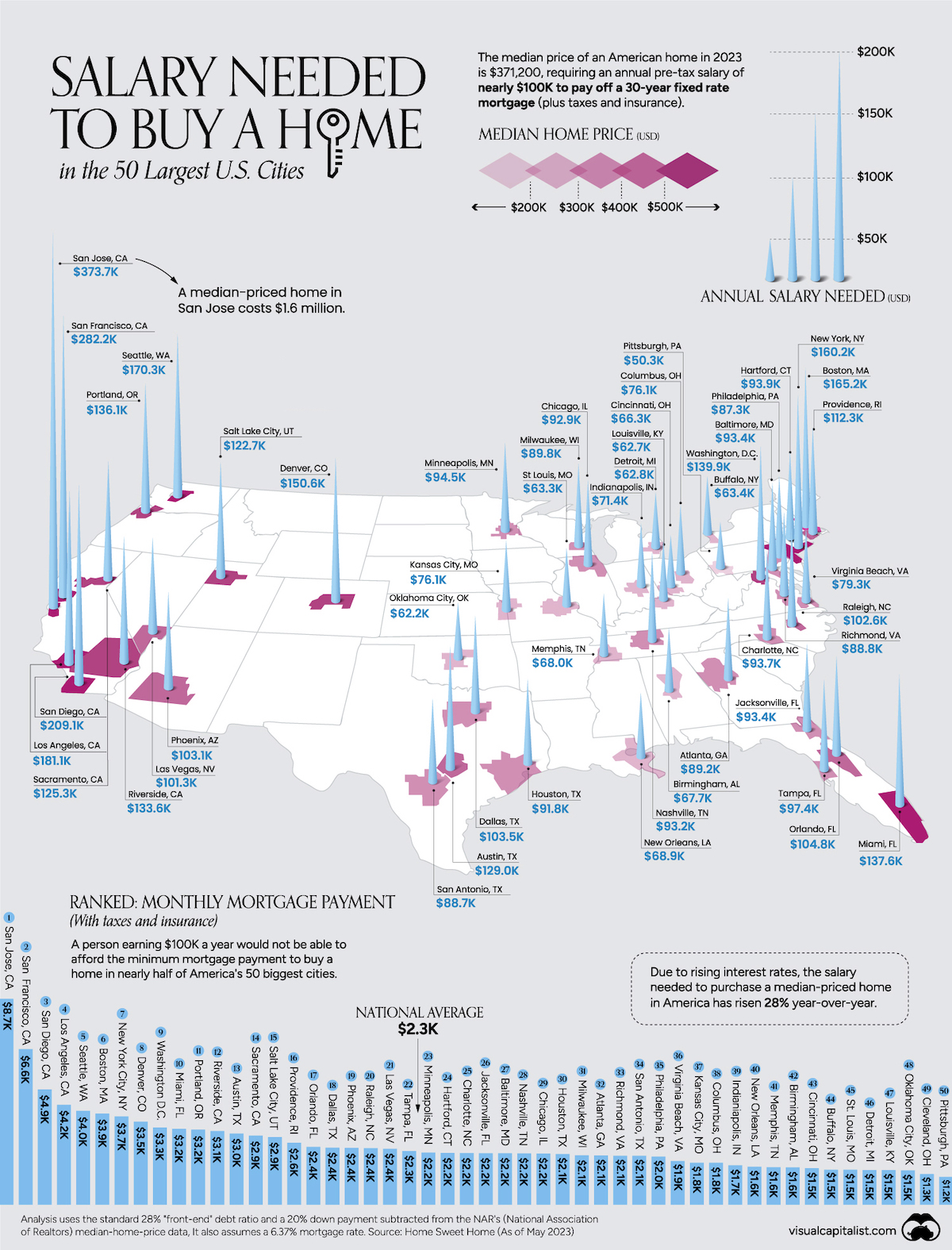
Mapped: What You Need to Earn to Own a Home in 50 American Cities

(Source: Home Sweet Home & Visual Capitalist)

A map of the U.S. with the median home price as well as the salary needed to own a home 50 American cities.

Once a fundamental part of the American dream, the ability to own a home is drifting farther and farther away for many Americans.

Between skyrocketing prices, stagnating wages, and now rising interest rates, the deck seems to be increasingly stacked against home ownership.

Using May 2023 data tabulated by Home Sweet Home, we map out the annual salary needed to afford a 30-year mortgage (at 6.37%) to buy a home in America’s 50 most populous metropolitan areas.

The monthly minimum mortgage payment includes taxes and insurance as well, and is capped at roughly one-third of the income. This analysis also assumes that the homeowner will put down a 20% down payment.

The Least and Most Affordable American Cities to Own a Home

At the top of the list, and at the very west of the country, San Jose is the least affordable city to own a home for the average American.

One would have to earn at least $374,000 a year to afford a $1.6 million dollar home in the city.

To put those numbers into perspective, the median American annual income is $75,000, about one-fifth what’s required to buy a home in San Jose.

Other Californian cities, San Francisco (ranked 2nd), San Diego (3rd), and Los Angeles (4th) all require an annual income of at least $180,000 to attempt home ownership within their metropolitan boundaries.

Boston (ranked 6th) and New York (ranked 7th) represent unaffordability on the East Coast, both requiring at least $160,000 a year to buy homes there.

It’s not just the coasts that are expensive however. To buy a home in Denver (ranked 8th) and Salt Lake City (15th) means earning more than $120,000 a year.

However, cities in the Midwest and South, like Pittsburgh, Detroit, Oklahoma City, and Louisville, are far more affordable, requiring less than $63,000 a year to buy a home.

Interest Rates Rock Home Ownership Chances

Aside from the obvious price differences in housing markets, a key factor that has elevated income requirements across the board is the rapid rise in interest rates in the last year. In fact the average 30-year mortgage has pushed past 7%, the highest it’s been since the 2000s.

This means that while the median price of a house in San Jose has actually come down between 2022 and 2023, the minimum monthly payment has increased from $7,717 to $8,720 this year.

So to afford a median-priced home in the country, an American needs to earn closer to $100,000 a year, up from $75,500 in 2022. And even then, they would be priced out of owning a home in nearly half of the 50 largest cities in the country.

As a result Americans may yet further delay home ownership. Renting is now a far more attractive option, thanks to the biggest difference between rent and mortgages in over 50 years.

Where Does This Data Come From?

Source: Home Sweet Home (HSH).

Note: HSH used different sources for their median home prices, mortgage rate, property taxes and home insurance figures for their analysis. Please visit their website for more information.

Other: If other personal debts exceed 8% of one’s given monthly gross income, this may increase the salary needed to qualify for a mortgage.

The full story is available: What You Need to Earn to Own a Home in 50 American Cities (visualcapitalist.com)

Read more

Fraud Protection

Fraud protection is essential in the title industry. Fraudulent wiring instructions have caused dramatic financial losses for title agents, realtors, homeownership, and homebuyers.

We want to keep you safe.

What we know:

    • Changes to wire instructions are not normal
    • Lender payoffs are being manipulated
    • Large losses are occurring in the industry
    • Payoff instructions are not verified

Safety Measures:

    • Question every single change to wire instructions, change requests are not normal and probably fraudulent
    • Do not reply directly to emails requesting the movement of money
    • Instead, use the “forward” option and type in the correct email address or select it from your email address book
    • Validate new payment instructions received via email—even if it is internal
    • Always verify the authenticity of each wire transfer request
    • Call, using a number you have previously called—not one from the current wire transfer request—to verify verbally
    • Verify payment instructions with any new vendor
    • Verify changes to payment instructions for an existing vendor
    • Verify pay-off account numbers before wiring funds

How can you avoid fraud?

  • Establish a verification protocol
  • Enforce the protocol with all employees
  • Re-review on a regular basis
  • Implement multi-factor authentication
Read more
  • 1
  • 2
Call Now Button